The Jaeger-LeCoultre Reverso was born from a polo match in India in 1930 — but Jaeger-LeCoultre neither invented the reversible case nor kept it to itself. Jaipur Watch Company's Flip Watch — a 40 × 30mm steel case with a lapis, malachite, tiger's eye or aventurine dial that pivots away to show a blank steel face — is the first serious Indian answer to it. Here is how they actually compare, and where the ₹45,000 watch beats the ₹8 lakh one on intent if not on watchmaking.
In the winter of 1930, on a polo field in India, a British army officer smashed the crystal of his wristwatch. A Swiss watch dealer named César de Trey was watching, and was reportedly challenged to produce something that could survive the game. What followed was a patent filed in Paris on 4 March 1931 by an independent French engineer named René-Alfred Chauvot, for a "watch capable of sliding in its casing and able to be flipped entirely on itself" — rights that de Trey bought from him that July. The Jaeger-LeCoultre Reverso. Ninety-odd years later, a watch company based in the city the legend usually names has built its own version. This is what Jaipur Watch Company's Flip Watch actually is, how honestly it stands next to the watch India inspired — and why the question "did JWC copy the Reverso?" has a more interesting answer than either yes or no.
The watch India set in motion
The Reverso's origin story is the most repeated anecdote in watchmaking, and unusually for such stories, its skeleton holds up: Chauvot's patent, FR712868A, is real and dated, and it describes exactly the mechanism the watch still uses. A capsule containing the movement, dial and crystal sits in a separate carrier with parallel grooves. Slide the capsule along the grooves, swivel it 180 degrees on its hinge, drop it back in, and the fragile crystal is now face-down against your wrist with a slab of solid steel presented to the world — and to the polo ball. The first watches measured about 38 × 23mm.
The detail everyone forgets is the second-order consequence. Chauvot had not just protected a crystal; he had accidentally created the only mass-produced wristwatch with a blank metal canvas on the outside. Within a decade Reverso backs were being engraved, enamelled and monogrammed, and that — not polo — is what made the watch immortal.
But did Jaeger-LeCoultre invent the flip?
No. This is the part of the story that almost never gets told, and it is more interesting than the polo anecdote — because it decides what JWC can fairly be accused of.
Start with Chauvot. He was not a Jaeger-LeCoultre engineer. He was an independent French designer who filed the patent in his own name, and César de Trey bought the rights to his 23-part case from him in July 1931, four months after the filing. Only that November did de Trey and Jacques-David LeCoultre set up a company, Spécialités Horlogères, to market it. Jaeger-LeCoultre's claim on the Reverso begins with an acquisition, not an invention.
Then look at what Spécialités Horlogères did with the case. Far from guarding it as a house signature, it sold the thing outward: through the 1930s, Patek Philippe, Vacheron Constantin and Cartier all built watches around the Reverso case. For its first decade the reversible case was less a Jaeger-LeCoultre icon than a component other maisons bought in.
And the idea was already on the market before Chauvot filed anything. Universal Genève's Cabriolet got there first: a small rectangular case seated inside a larger outer frame, released by a screw so the inner case could be tipped over and snapped back. Its dating is genuinely contested — enthusiast sources and auction records put it at 1927–29, and Antiquorum sold a 1929-dated Staybrite example in Geneva in 1994, while Universal Genève's own current account dates the launch to 1933. The specification, though, is not in dispute, and it is not the Reverso's.
Cartier then patented a third route in 1932 with the Tank Basculante, whose case tips over inside a fixed outer frame on the twelve-to-six axis. Cartier's own name for it was the Cabriolet Réversible.
So there are two distinct engineering answers to the same problem, and the Reverso is only one of them:
- The cradle. The capsule slides out along grooves, hinges through 180 degrees, and drops back into its carrier. This is Chauvot's patent, and it is the Reverso — and only the Reverso.
- The frame. The inner case is released and pivots over inside a surrounding frame that it never actually leaves. This is the Cabriolet, the Basculante — and, as it turns out, the JWC Flip Watch.
Why the legend keeps saying Jaipur
Different tellings place the match in different cantonments, but Jaipur is the one that recurs, and there is a reason beyond romance. Through exactly the period the Reverso was conceived, Jaipur was not merely a place where polo was played — it was the best polo team on earth. Maharaja Sawai Man Singh II's side, with Rao Raja Hanut Singh, Prithi Singh and Abhay Singh, won the Indian Open Championship every year from 1930 to 1938. In 1933 they toured England and won everything they entered, including the Hurlingham Championship Cup. If you were a Swiss watch dealer looking for the sport's centre of gravity in 1930, you looked at Rajasthan.
So there is a real symmetry in the fact that the Indian brand which finally built a flip watch is Jaipur Watch Company — and that its Shopify product handles still read rajasthan-polo-watch.
What Jaipur Watch Company actually built
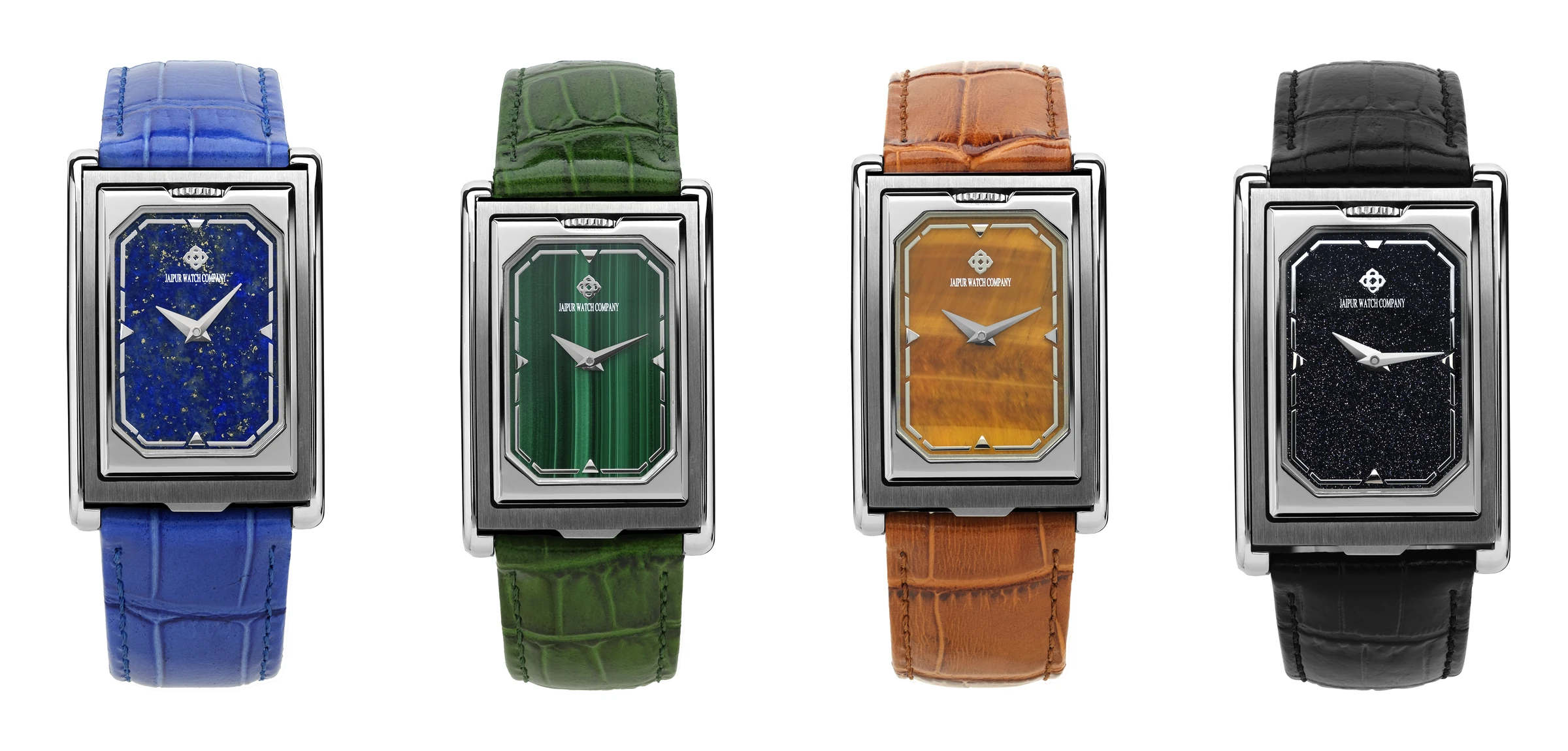
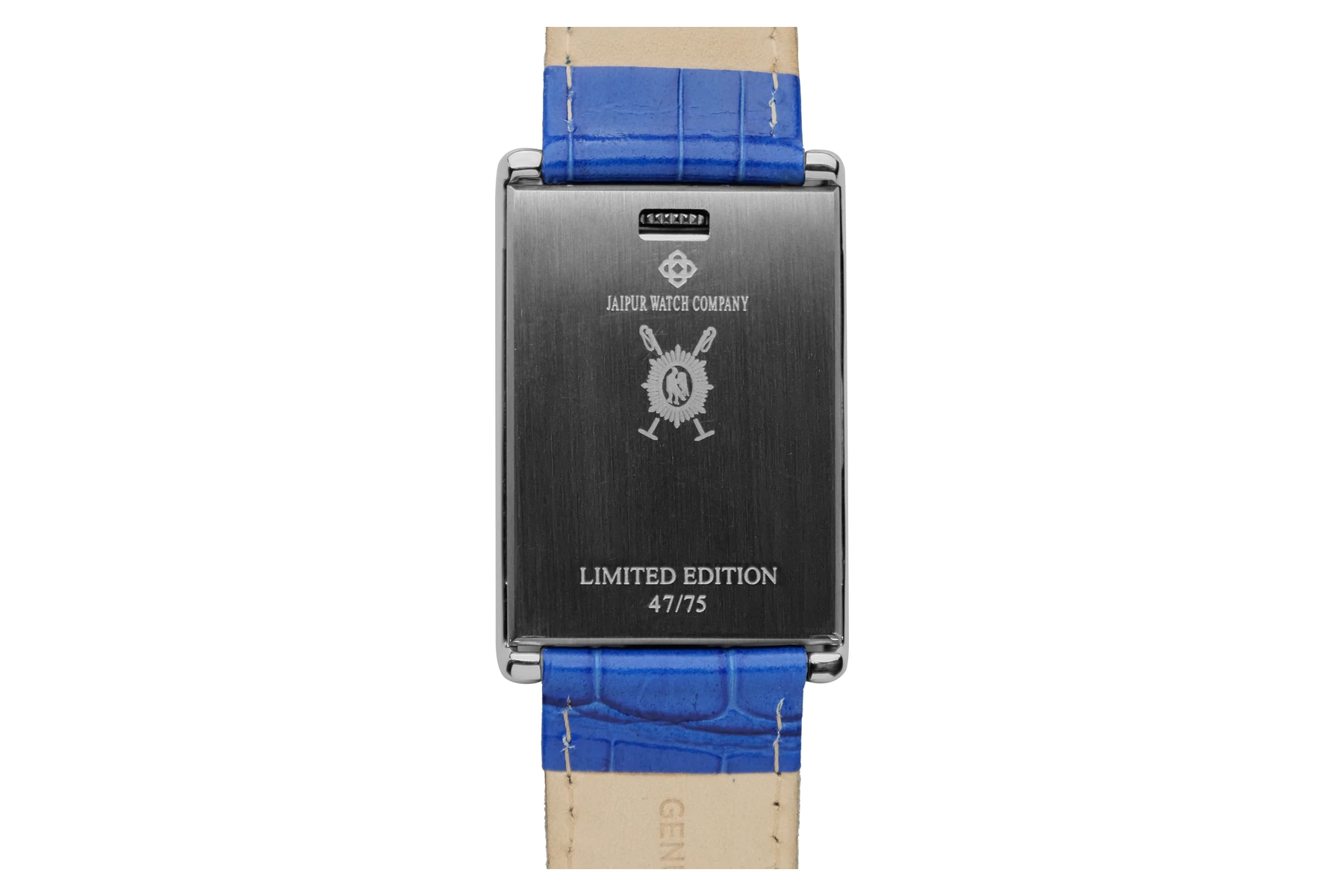
The Flip Watch is a 40 × 30mm rectangular watch in 316L stainless steel, 9mm thick, under sapphire, on a 22mm leather strap. The dial is a slab of semi-precious stone — lapis lazuli, malachite, tiger's eye or blue aventurine — and the movement is a Miyota 2025 quartz. Each of the four is limited to 75 pieces at ₹45,000, or ₹50,000 customised. All four have sold out, though JWC continues to take commissions.

The case is the interesting part, and it is what settles the copying question. Where the Reverso's capsule slides out along its grooves and then hinges over, JWC's inner case pivots inside its outer carrier and never leaves it — and JWC describes that pivot as operating on a vertical axis, which is Basculante vocabulary, not Chauvot's. Functionally the outcome is identical: stone dial protected, blank steel outward. Architecturally, the Flip Watch sits in the frame lineage, which is the older of the two.
Head to head
| JWC Flip Watch | JLC Reverso Classic Monoface | |
|---|---|---|
| Launched | 2024 | 1931 |
| Made in | Jaipur, India | Le Sentier, Switzerland |
| Case | 40 × 30mm, 9mm thick, 316L steel | ~45.6 × 27.4mm, ~8.5mm, steel |
| Reversing action | Capsule pivots inside an outer carrier | Capsule slides in a cradle, hinges 180° |
| Case lineage | Frame-pivot (Cabriolet, Basculante) | Sliding cradle (Chauvot patent) |
| Movement | Miyota 2025 quartz | In-house hand-wound mechanical |
| Dial | Semi-precious stone slab | Lacquered or guilloché metal |
| Reverse face | Brushed steel, edition number engraved | Brushed steel, engraving to order |
| Production | 75 pieces per dial | Continuous since 1931 |
| Price | ₹45,000 | Roughly ₹5.5–8.5 lakh |
The honest comparison
It would be easy — and wrong — to write this up as "India's Reverso." The Reverso is a hand-wound Swiss manufacture watch with ninety-four years of continuous production, an Art Deco case that is genuinely one of the great industrial designs of the twentieth century, and a resale market. The Flip Watch is a quartz watch at one-fifteenth the price. Anyone comparing them on watchmaking is comparing a novel to a short story.
What the Flip Watch is not, though, is a knock-off. It uses the older frame-pivot architecture rather than Chauvot's cradle, and the concept it draws on was a shared one from the start — an acquired patent that Spécialités Horlogères happily sold to Patek Philippe, Vacheron Constantin and Cartier. "Reversible rectangular watch" is a category, not a Jaeger-LeCoultre trademark, and it has been since before the Reverso existed.
But that is not the interesting axis. On design intent, the Flip Watch does something the Reverso never has: it makes the reversal necessary rather than ceremonial. A Reverso's dial is lacquer and steel — flipping it is a gesture. A lapis or malachite dial is a mineral slab that will scuff, and turning it inward is a thing you would actually do. JWC picked the one dial material that gives the mechanism a job again.
The quartz movement is the honest weak point, and it is worth saying plainly: at ₹45,000 a Miyota 2025 is a cost decision, not a design one, and a mechanical Flip Watch is the obvious next version. The case, the stone and the engraving are where the money visibly went.
The four stones
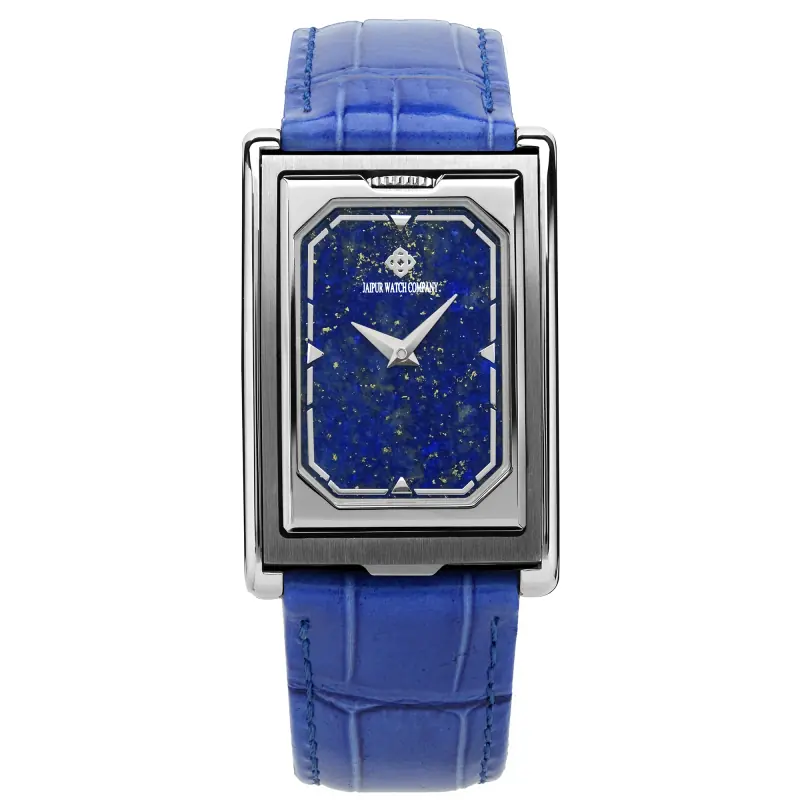
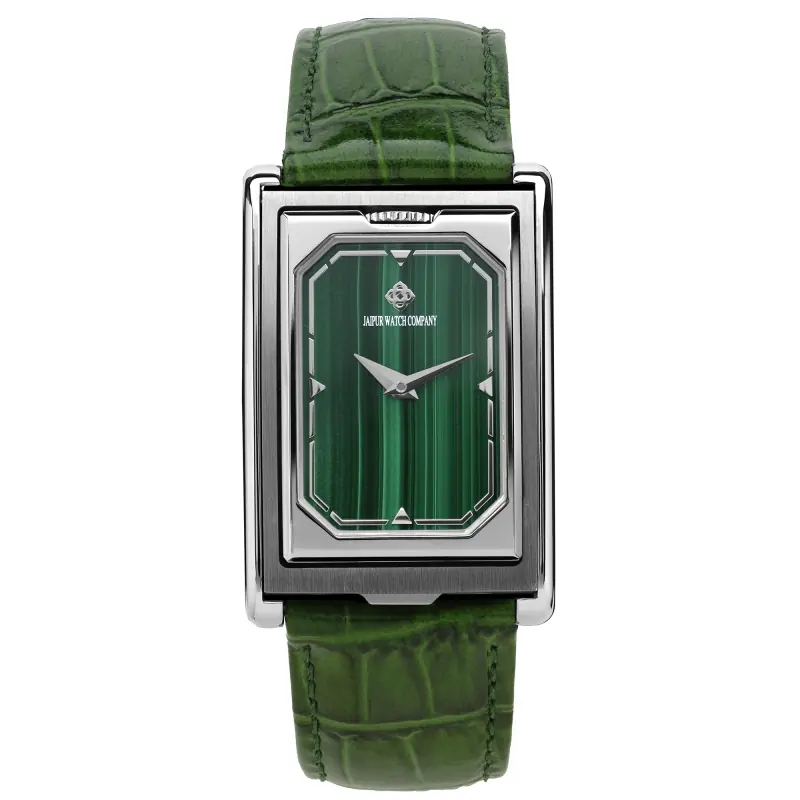
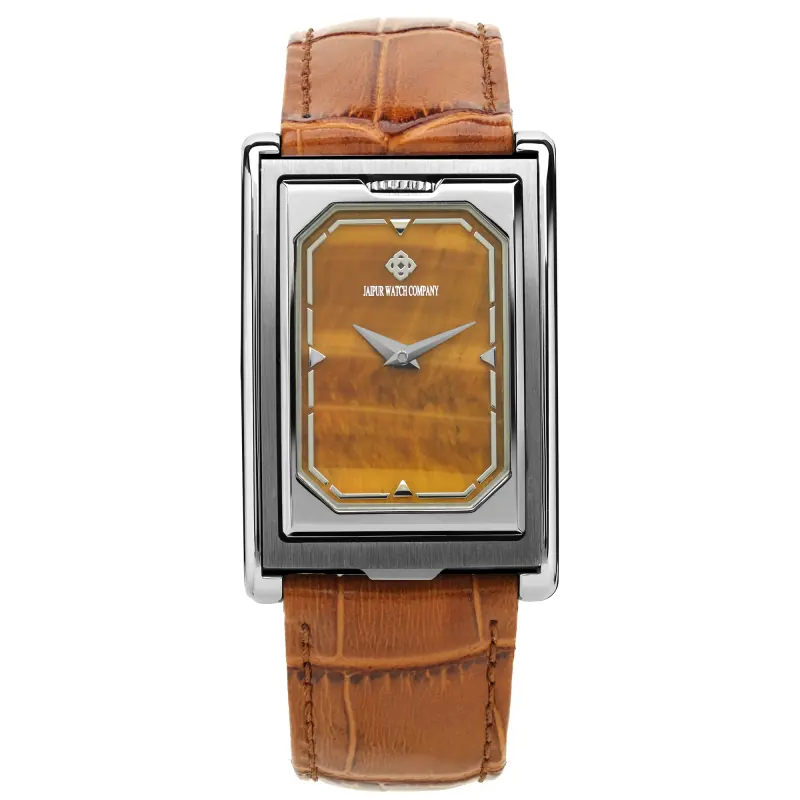
All four share the same case, movement and price; the only variable is the mineral, and it changes the watch more than you would expect.
Jaipur Watch Company
Flip Watch — Lapis Lazuli
₹45K
Jaipur Watch Company
Flip Watch — Malachite
₹45K
Jaipur Watch Company
Flip Watch — Tiger's Eye
₹45K
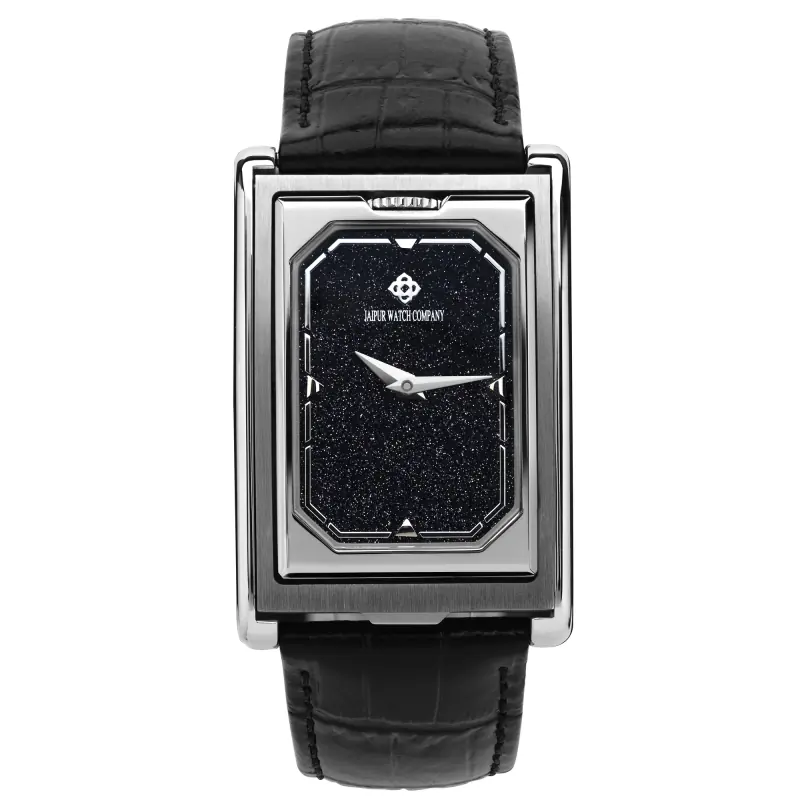
Jaipur Watch Company
Flip Watch — Aventurine
₹45K
JWC's other reversible watch
Worth knowing, because it is arguably the more ambitious idea: the Gates of India series is also a flip watch, but with a dial on both faces and a TMI dual movement driving two independent time displays — Jaipur's Leheriya-patterned City Palace gate on one side, the Charminar, Red Fort or India Gate on the other, hand-painted onto mother-of-pearl. Each takes around seven weeks to finish. The Flip Watch is the disciplined, wearable execution of the reversible case; Gates of India is the maximalist one.
Verdict
The Flip Watch is the most conceptually satisfying thing Jaipur Watch Company has made, because it is the rare Indian watch whose reference point is a story India actually owns. A brand in Jaipur, building a polo watch with a reversing case and mallets engraved on the back, is not borrowing Swiss heritage — it is claiming a share of it, through a lineage that was never Jaeger-LeCoultre's to own in the first place. That the movement is quartz is a fair criticism and a solvable one. That the idea is right is not really arguable.
If you want one, the original 75-piece runs are gone, but JWC takes commissions directly. If you want the mechanism with more watchmaking behind it, save for the Reverso — and know that you are buying a watch designed for a game India was, at the time, the best in the world at.
Frequently asked questions
Did Jaeger-LeCoultre invent the reversible watch?
No. The Reverso's case was patented by an independent French engineer, René-Alfred Chauvot, on 4 March 1931, and César de Trey bought the rights from him that July. Reversible wristwatches already existed — Universal Genève's Cabriolet, whose inner case pivots inside an outer frame, predates it — and through the 1930s the Reverso case was supplied to Patek Philippe, Vacheron Constantin and Cartier as well. Cartier patented its own reversible Tank, the Basculante, in 1932.
Is the Jaipur Watch Company Flip Watch a copy of the Reverso?
No. It shares the concept of a reversible case protecting the dial, and JWC is open about the polo connection, but the mechanism differs: the Reverso's capsule slides along a grooved cradle and hinges over, while the Flip Watch's capsule pivots inside an outer carrier without leaving it — the same architecture as the earlier Universal Genève Cabriolet and Cartier Basculante. The Flip Watch also uses stone dials and quartz, where the Reverso uses lacquered dials and mechanical calibres.
How much does the JWC Flip Watch cost?
₹45,000, or ₹50,000 with customisation. Each of the four stone-dial variants was limited to 75 pieces and all have sold out, though Jaipur Watch Company still accepts commissions.
Was the Jaeger-LeCoultre Reverso really invented in India?
The Reverso was conceived in response to a problem observed at a polo match in India in 1930 — most tellings place it in Jaipur — and patented in France in March 1931. The watch itself was designed and built in Switzerland by Jaeger-LeCoultre, with the case designed by French engineer René-Alfred Chauvot.
What movement does the JWC Flip Watch use?
A Miyota 2025 quartz movement, under a sapphire crystal, in a 40 × 30mm 316L stainless steel case 9mm thick.
Which stone dial should I choose?
Lapis lazuli is the most classically beautiful and the easiest to wear; malachite is the boldest; tiger's eye moves the most in light; blue aventurine is the most discreet and the best evening option. All four are identical in specification.