Every watch you've ever worn moves its hands in one direction. Left to right across the top, right to left across the bottom. You call it 'clockwise' — but clocks didn't invent that direction. Sundials did, 5,000 years ago. The answer involves shadows, hemispheres, and a decision that the entire world now follows without questioning.
What Does "Clockwise" Actually Mean?
"Clockwise" describes the direction in which the hands of a clock move: from the 12 to the 3, then to the 6, then to the 9, and back to the 12. Left to right across the top half of the dial. It is the direction so universal that we use it to describe everything from tightening a bolt to stirring a pot.
The word itself appeared in the English language around the 1870s — surprisingly late, given that mechanical clocks had existed for 500 years. Before that, English speakers said "sunwise" or simply "with the sun." The Scots Gaelic word deiseil (sunwise) carried the same meaning and was considered the auspicious direction — walking sunwise around a church or a fire was a blessing. Walking counter-sunwise was an invitation to bad luck.
The German equivalent is im Uhrzeigersinn — literally "in the sense of the clock hand." The French say dans le sens des aiguilles d'une montre — "in the direction of the hands of a watch." Every language arrived at the same idea independently: the direction of the hands defines the direction of rotation.
Why That Direction? Sundials.
Before mechanical clocks, humanity told time with shadows. A stick driven into the ground — a gnomon — casts a shadow that moves as the sun crosses the sky. The oldest known sundial dates to approximately 1500 BCE in Egypt, though the principle was understood far earlier. The Babylonians, Egyptians, Greeks, and Romans all used sundials.
In the Northern Hemisphere, the sun rises in the east, arcs across the southern sky, and sets in the west. The shadow of a gnomon therefore moves in the opposite direction: it starts pointing west at dawn, swings through north at midday (when the sun is due south), and points east at dusk. Traced on the ground, this shadow path moves from left to right across the top — the direction we now call clockwise.
When medieval European clockmakers built the first mechanical clocks in the 13th and 14th centuries, they designed the hands to move in the same direction as sundial shadows. Not because they had to — there is no mechanical reason for a clock to run in one direction over another. They did it because the direction was already intuitive: everyone had spent their lives watching sundial shadows move that way.
What If Clocks Had Been Invented in the Southern Hemisphere?
South of the equator, the sun arcs across the northern sky. Sundial shadows move in the opposite direction — right to left across the top. Counter-clockwise. If the mechanical clock had been invented in Australia, Argentina, or South Africa, "clockwise" would be what we currently call counter-clockwise.
This is not a thought experiment. There are novelty "Southern Hemisphere" clocks that run counter-clockwise with reversed number placement (12 at top, but 1 to its left). They work perfectly. They feel wrong only because 700 years of Northern Hemisphere convention has trained our brains to expect one direction.
At the equator, sundial shadows don't favour either direction strongly — the sun passes almost directly overhead. The convention is purely inherited.
The Mechanics: What Actually Makes the Hands Move
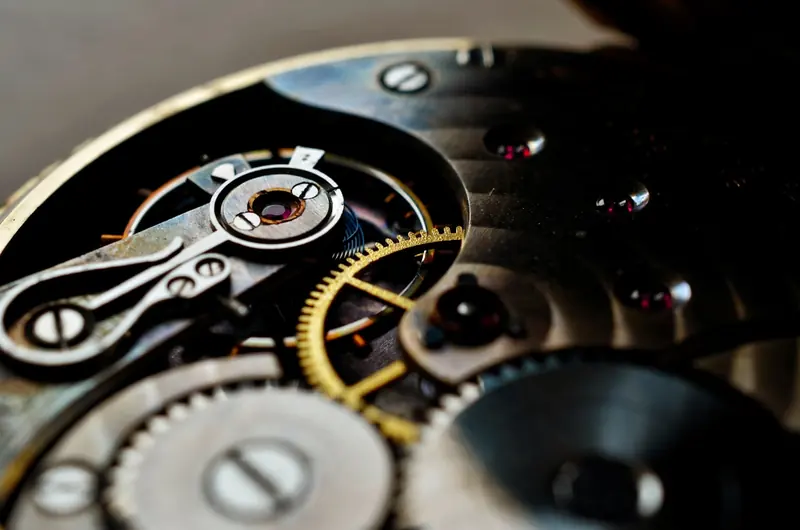
Inside a mechanical watch, the mainspring stores energy. As it unwinds, it transmits force through a series of gears called the gear train. The gear train steps down the mainspring's power, distributing it across hours of measured release. The escapement — a lever and escape wheel working together — regulates this release, parcelling out energy in precise, metered ticks.
The direction of hand rotation is determined by the gear train's configuration. It is a design choice, not a physical necessity. The gears could be arranged to drive the hands either way. Every mechanical watch that moves clockwise does so because the watchmaker designed the gear train to produce that rotation — honouring a convention that traces back through mechanical clocks, through sundials, to the geometry of Earth's orbit around the sun.
In a quartz watch, a battery sends an electrical current through a tiny quartz crystal, which vibrates at exactly 32,768 times per second. A circuit counts those vibrations, divides them down to one pulse per second, and drives a stepper motor that advances the second hand. Again, the clockwise direction is engineered, not inevitable.
The Rare Exceptions
Counter-clockwise watches exist, and not just as novelties. In Jewish tradition, some synagogue clocks in Prague and other European cities run counter-clockwise with Hebrew numerals — Hebrew reads right to left, and these clocks follow the same logic. The most famous is the Hebrew Clock on Prague's Jewish Town Hall, installed in the 18th century and still running today.
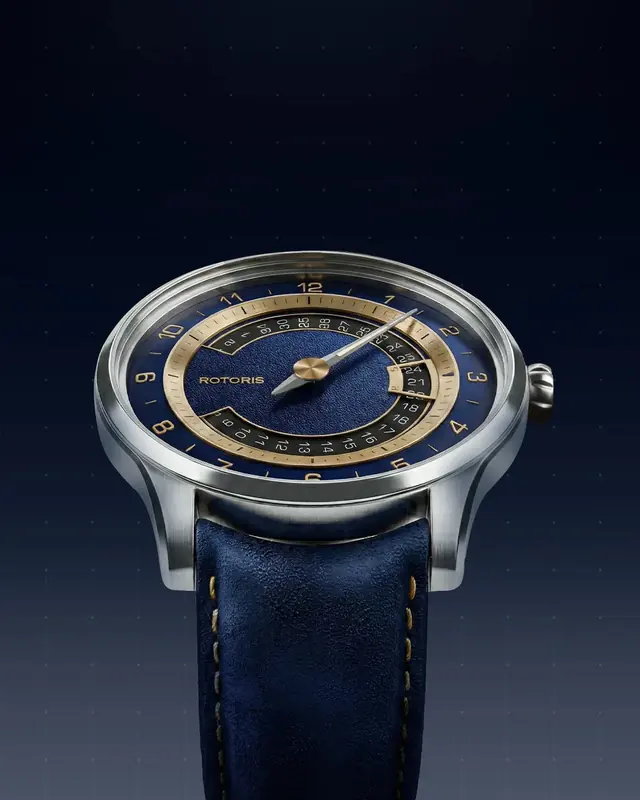
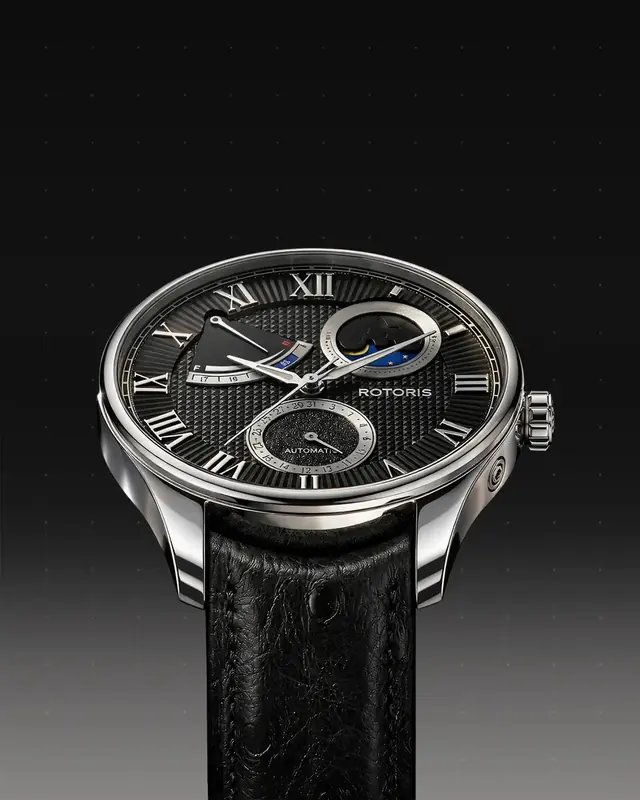
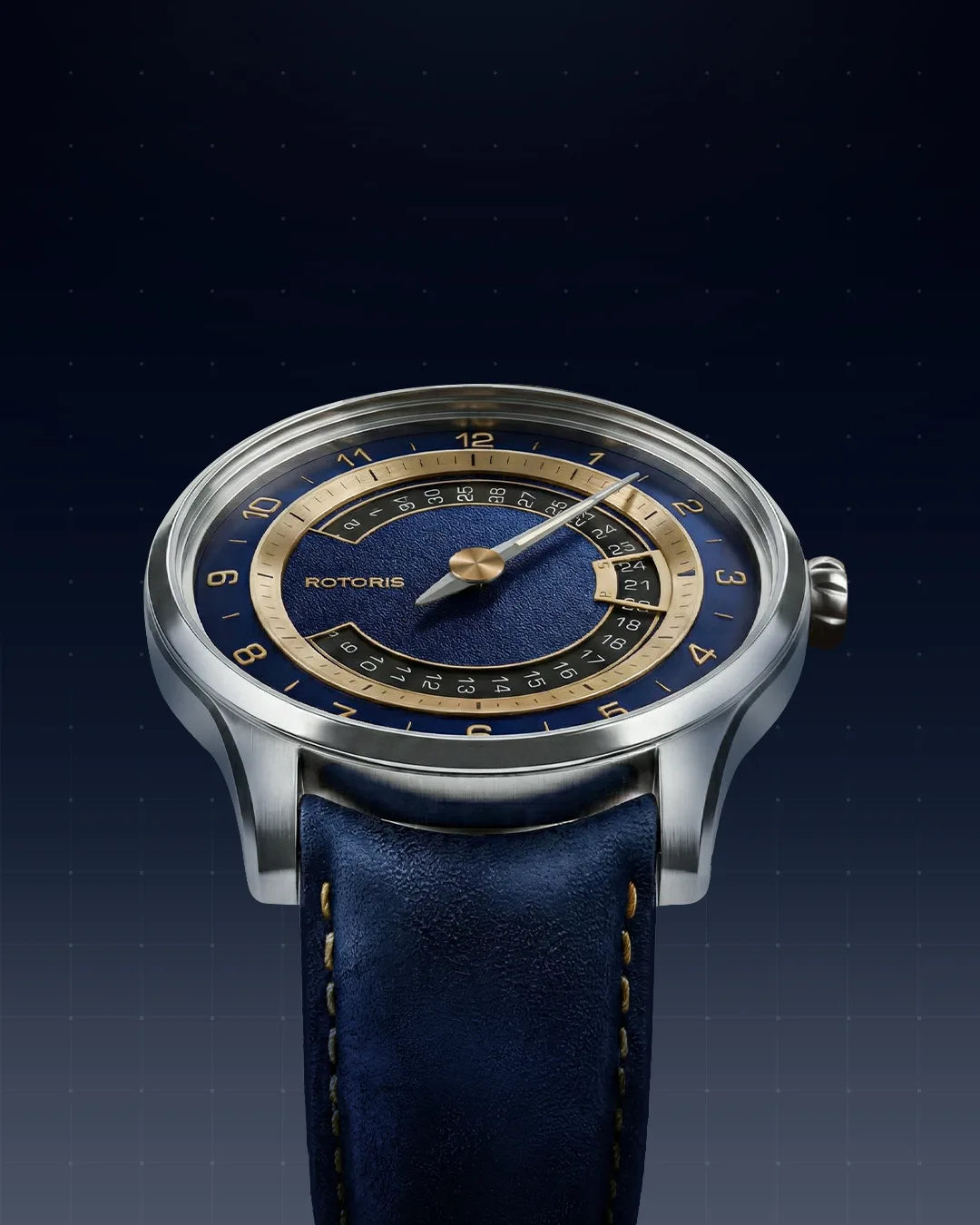
In watchmaking, counter-clockwise complications appear in serious horology. Retrograde displays — where a hand sweeps forward to its limit, then snaps back to zero — are a respected complication found in watches from brands like Jaeger-LeCoultre and A. Lange & Söhne. The Rotoris Arvion, from India's most ambitious watch brand, uses a single-hand display that reframes how you read rotation entirely — one hand, one revolution per twelve hours, forcing you to think about direction and position differently.
Clockwise in Indian Tradition
The sunwise direction carries deep significance in Indian culture. In Hindu practice, pradakshina — the act of walking clockwise around a temple, a deity, or a sacred fire — is a fundamental form of reverence. The devotee keeps the sacred object to their right, the auspicious side. The direction follows the sun's apparent path across the Indian sky.
When you wear an Indian watch — a DWC Vayu, a JWC coin dial, a Rotoris Monarch — and watch its hands move clockwise, you are watching a convergence: Northern Hemisphere astronomy, medieval European engineering, and an ancient Indian understanding of what it means to move with the sun. The watch hand's direction is a 5,000-year inheritance you check 50 times a day without thinking about it.
So Why Clockwise?
Because the Earth tilts 23.4 degrees on its axis. Because that tilt means the sun traces different paths in different hemispheres. Because humans in Egypt and Mesopotamia noticed the shadows. Because medieval Europeans built machines that copied those shadows. Because those machines became the standard for the entire world. Because no one ever had a reason to change it.
Your watch goes clockwise because of astronomy, geography, and a chain of convention that no one broke. It's one of those answers that starts simple — "because that's how clocks work" — and ends at the orbit of the planet.