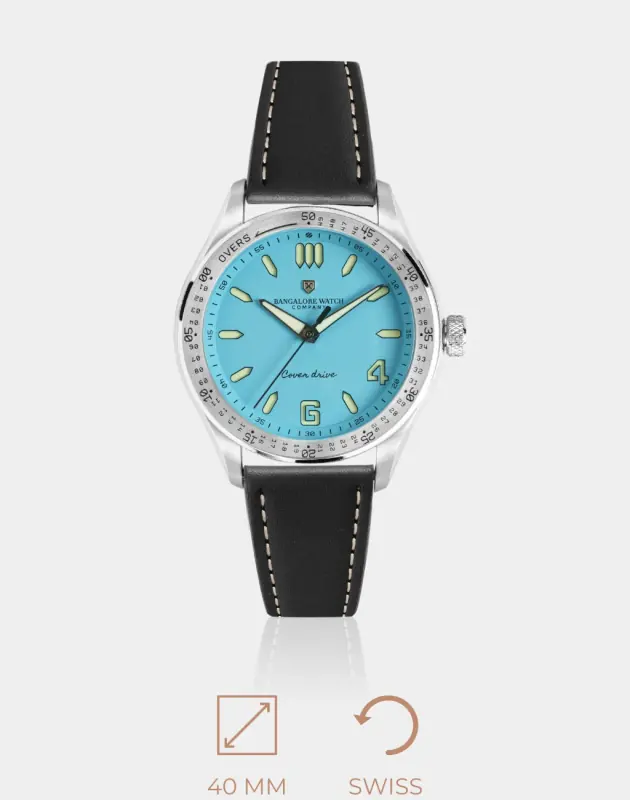
Six Indian watches from four brands are competing at the GPHG 2026, watchmaking's Oscars. Here is the full list — and what it means for Indian watchmaking.
Six Indian watches from four brands are competing at the GPHG 2026 — the Grand Prix d'Horlogerie de Genève, widely called the Oscars of watchmaking — the largest Indian showing the competition has ever seen. Titan, Delhi Watch Company, Bangalore Watch Company, and Jaipur Watch Company all placed timepieces in this year's field. The awards ceremony follows in Geneva on 7 November.
Update, 1 September 2026: the GPHG Academy has published its nominated shortlist, and no Indian watch made it — all six entries below fell at the first cut. India's real 2026 breakthrough came elsewhere: Ethos CEO Pranav Shankar Saboo is now one of the 24 jurors choosing the winners. We cover that in full in our report on the GPHG 2026 nominations.
Two years ago, this was unthinkable. In 2024, a single Indian brand had ever reached the GPHG. Now four are competing in one edition — and not with novelties, but with an in-house wandering-hour complication, an ultra-thin mechanical calibre, a dial made from captured atmospheric carbon, and heritage pieces engraved by hand.
This guide lists every Indian watch at the GPHG 2026, category by category, and explains what the moment actually means — why competing in Geneva, even before a single prize is awarded, has already changed the standing of Indian watchmaking.
Key Takeaways
- Four Indian brands — Titan, Delhi Watch Company, Bangalore Watch Company, and Jaipur Watch Company — are competing at the GPHG 2026 with six watches in total.
- This is the broadest Indian presence ever, up from three brands in 2025 and just one (Titan) in 2024.
- Titan's Wandering Meteor debuts India's first in-house wandering-hour complication; the DWC Terra is a titanium field watch limited to 5,555 pieces.
- The 2026 field held 320 watches from 194 brands, cut to 84 nominees on 1 September — none of them Indian. The ceremony is on 7 November.
- A place in the GPHG field is decided by an independent academy, not marketing — so it is validation Indian brands have earned on merit.
What is the GPHG?
The GPHG, or Grand Prix d'Horlogerie de Genève, is the watch world's most prestigious awards competition, founded in 2001 and widely called the Oscars of watchmaking. Each year an independent academy and international jury review hundreds of entries, announce a nominated shortlist, then award prizes across a range of categories — the top honour being the Aiguille d'Or, the "Golden Hand."
What gives the GPHG its authority is the filter. Any brand can enter, but an independent body decides which watches are shown and judged. Marketing budgets do not buy a place in the conversation. For a watchmaking nation still writing its first chapters, therefore, simply being among the competing watches is a credential in itself.
Every Indian watch at the GPHG 2026
The 2026 edition is the breakthrough in breadth. Where earlier years leaned on a single brand or a lone complication, this year spans four brands, six watches, and wildly different philosophies — from titanium tool watches to hand-painted heritage art. Here is the full roster.
Titan: two directions at once
Titan, the brand that opened this door in 2024, brought two very different entries. The Edge UltraSlim Mechanical competes in the Essential category: a 40mm titanium watch just 5.7mm thick, driven by the hand-wound, skeletonised Calibre Edge 903 with a 42-hour reserve. Its dual-disc display replaces conventional hands entirely — a quiet, radical take on reading the time.
The Wandering Meteor, in the Challenge category, is the statement piece. Priced around ₹1.8 lakh, it debuts India's first in-house wandering-hour complication, wrapped in a crystallised titanium case built around exploration and celestial themes. A wandering-hours display is a genuinely difficult complication, and building one in-house is the kind of leap that separates an assembler from a watchmaker.
Delhi Watch Company: the titanium field watch
The DWC Terra enters the Challenge category and carries a specific engineering pedigree. Its titanium case measures 33.8 × 42.2mm at 9.1mm thick, with carabiner-inspired geometry cut using water-jet and wire-EDM machining to tolerances of ±20 microns. Released as a 5,555-piece series, it reads as a tool watch that treats precision manufacturing, not decoration, as the point.
Consequently, the Terra's presence matters because it proves the story is not only about six- and seven-figure showpieces. A rugged, made-in-India titanium field watch earning a place beside the world's grandes maisons says something about how far the baseline has risen. We put it through a full field test of the DWC Terra to see how it wears in the real world.
Bangalore Watch Company: material innovation
Bangalore Watch Company returns to the Challenge category with the Carbon, and its headline is the dial. The brand's ReforgeCarbon dial is made from atmospheric carbon particulate — captured, then compressed with thermoset resin — producing a marbled pattern that never repeats between watches.
Specifically, it is a sustainability idea turned into a material signature, and exactly the kind of independent thinking the GPHG academy rewards with attention. The result is a watch whose story lives in what the dial is made of, not just how it looks.
Jaipur Watch Company: heritage as craft
Jaipur Watch Company, the specialist in cultural storytelling, brought two entries. The Premium Baagh Gaurav Mehta Signature Series, in the Challenge category, is a 40mm steel watch with hand-engraved flanks and a multi-layered dial combining a turquoise mosaic, pink Khadi fabric, a ruby-set pavilion, and a sculpted golden tiger, running a Swiss Sellita SW200 automatic. The Maharana Pratap Stamp Watch Automatic, in the Time Only category, turns historical Indian postal art into a dial — heritage delivered through classic two- and three-hand timekeeping.
Together, Jaipur's pair make the case that Indian craft traditions — engraving, textile, miniature detail — are a legitimate artistic language on the world stage, not a regional curiosity.
From one brand to four: how India got here
To grasp how big 2026 is, trace the two years before it. In 2024, Titan became the first Indian brand ever to compete at the GPHG, entering two Edge models in the Time Only and Challenge categories. Nothing won. That was never the point — a Geneva academy simply agreeing to show Indian watches was the achievement.
In 2025, the field widened to three brands, including Titan's first home-grown tourbillon and an accessible microbrand diver. Then 2026 pushed it wide: four brands, six watches, spanning a titanium field watch to a hand-engraved tiger and India's first in-house wandering hours.
That progression — one, then three, then four — is not luck. It is an ecosystem forming in real time: designers, movement developers, artisans, and independents all reaching the same stage within three years. To see the wider field, our complete guide to Indian watch micro-brands maps every maker worth knowing.
What GPHG selection means for Indian watchmaking
Here is the honest caveat: no Indian watch has ever won a GPHG prize, and the 2026 winners are not known until 7 November. So what is everyone celebrating before the results are in? Validation that cannot be bought.
A brand can spend on advertising, but it cannot spend its way into the GPHG's serious consideration — an independent academy decides who competes and who makes the nominated shortlist. When that body puts Indian watches into a field of 320 watches from 194 brands alongside Audemars Piguet, Chopard, and IWC, it confirms they meet a real standard of design, finishing, and mechanical credibility.
As a result, the effects are concrete. It raises the ceiling: Indian brands now know complications like wandering hours are achievable at home. It reframes the buyer's instinct — an Indian watch is no longer automatically the "value" alternative to something European. And it gives the ₹6.7-billion Indian watch market a credibility on the world stage that it lacked a decade ago.
The bigger picture: India on the world stage
For most of the last century, fine watchmaking recognised a short list of origins, and India was a customer of that list, not a member. The 2026 edition quietly redraws that map — on merit, one entry at a time.
The breadth is what convinces. This is not one vanity project. It is a titanium field watch, a carbon-dial diver, an in-house wandering-hours complication, and hand-engraved heritage pieces, all reaching Geneva in the same year, from four independent Indian houses. That is the signature of a maturing industry, not a one-off headline.
The next milestone was always going to be a nomination, and on 1 September 2026 it did not arrive: the Academy's 84-watch shortlist contains no Indian brand. That is the third consecutive edition in which Indian watches have competed without advancing, and it sets the real benchmark for 2027. Our analysis of the GPHG 2026 nominations breaks down which watches took the Challenge slots instead, and what separated them from India's entries.
To see these in motion, search YouTube for "Titan Wandering Meteor GPHG 2026" and hands-on coverage of the DWC Terra; the wandering-hours display and the Terra's machined case read very differently on video than on paper.
Frequently asked questions
How many Indian watches are at the GPHG 2026? Six watches from four Indian brands — Titan, Delhi Watch Company, Bangalore Watch Company, and Jaipur Watch Company — are competing in the 2026 edition, the largest Indian presence in GPHG history.
Which was the first Indian brand at the GPHG? Titan, through its Edge line, became the first Indian brand to compete at the GPHG in 2024, entering the Edge Squircle and Edge UltraSlim.
Has any Indian watch won the GPHG? No. Indian brands have competed since 2024, but none has won a prize — or even reached the nominated shortlist. All six 2026 entries were cut on 1 September 2026.
Was any Indian watch nominated at the GPHG 2026? No. The Academy narrowed 320 competing watches to 84 nominees across 14 categories, and no Indian brand was among them. India's representation this year is on the jury instead: Ethos CEO Pranav Shankar Saboo is one of its 24 members.
What is the Titan Wandering Meteor? It is Titan's 2026 GPHG entry in the Challenge category, notable for debuting India's first in-house wandering-hour complication in a crystallised titanium case, priced around ₹1.8 lakh.
The bottom line
Indian watches at the GPHG 2026 are the clearest signal yet that Indian watchmaking has crossed from aspiration into credibility. In three years the country went from Titan's lone debut in 2024 to four brands and six watches in 2026 — a titanium field watch, a captured-carbon dial, hand-engraved heritage art, and India's first in-house wandering hours, all competing in Geneva at once.
No trophy has come home, and after 1 September 2026 no nomination has either — the shortlist passed India over entirely. That is the honest ceiling as it stands: Indian brands have earned a place in the field, not yet in the final 84. For collectors, the takeaway is still that these are contenders rather than merely the value option, but the gap to Geneva's standard is real and worth naming. Read what the nominations revealed, then our field test of the GPHG-competing DWC Terra to meet one of the six up close.