Ethos is India's largest luxury watch retailer. Its parent, KDDL, has been manufacturing dials and hands in Himachal since 1981 and supplies Swiss brands. Together with Favre Leuba, acquired in 2023, they form the only Indian group that spans components, a Swiss brand and retail — the structure Yashovardhan Saboo openly compares to Richemont.
If you have bought a Rolex, an Omega or a Tudor in India, you have almost certainly dealt with Ethos. It is the country's largest organised luxury watch retailer, it is listed, and it is the name on the boutique.
What far fewer people know is who owns Ethos — and that the answer explains a great deal about where Indian watchmaking is actually heading. The parent is KDDL Limited, a Chandigarh company founded in 1981 that does not sell watches at all. It makes them, or rather makes the parts inside them: dials, hands and precision components, manufactured in India and exported to Swiss brands. And since 2023, through a Swiss holding company, the group also owns Favre Leuba — a 289-year-old Swiss maison that this year reached the GPHG 2026 nominated shortlist.
Components at one end, a Swiss brand in the middle, India's biggest luxury retailer at the other. No other Indian group has all three. This is how it fits together.
Key Takeaways
- KDDL Limited (Chandigarh, est. 1981) is the parent. It manufactures watch dials, hands and precision components — and is the majority owner of Ethos.
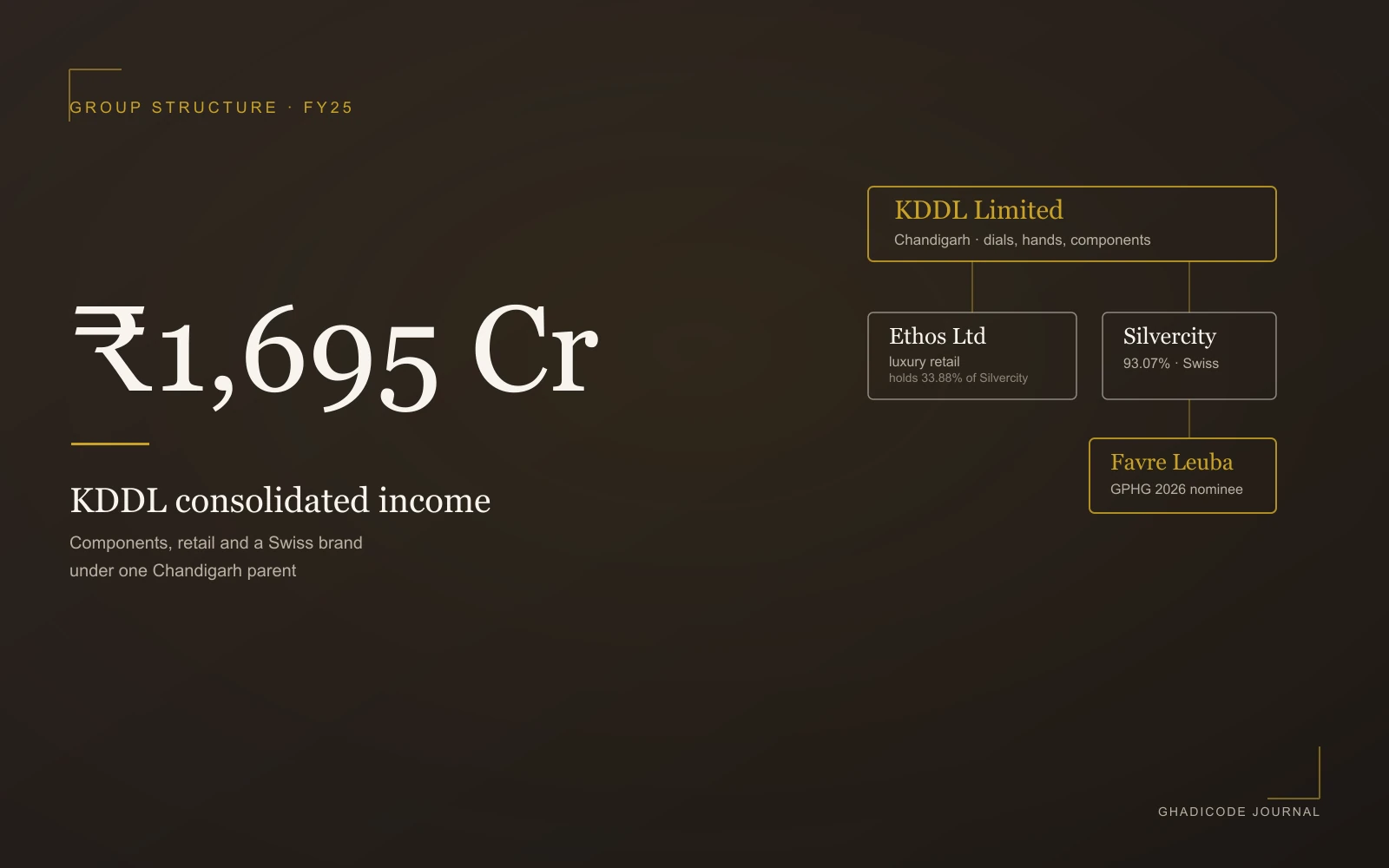
- Group consolidated income was ₹1,695 crore in FY25, with EBITDA of ₹307 crore (18.1%) and PAT of ₹142.3 crore. KDDL standalone was ₹384 crore.
- The group owns Favre Leuba through Silvercity Brands AG, of which KDDL holds 93.07% directly and indirectly; Ethos separately holds 33.88% of Silvercity.
- Chairman Yashovardhan Saboo explicitly frames the strategy as verticalisation, naming Richemont as the model.
- The weak link is deliberate and known: the group does not yet make watch cases, and says it intends to.
Who is KDDL?
KDDL was incorporated in 1981 to manufacture watch dials, at a time when India's watch industry meant HMT and little else. Four decades later it is a components business with a Swiss customer base, and it describes itself accordingly: manufacturing and distribution of dials, watch hands and precision components.
Its operating brands are worth separating, because the group name hides them:
| Business | What it does |
|---|---|
| KDDL / Taratec | Watch dials and hands, manufactured in India |
| Estima AG | Swiss-made dials and hands, based in Switzerland |
| Eigen | Precision engineering — components beyond watchmaking |
| Ornapac | Luxury packaging, largely for watches and jewellery |
| Ethos Limited | Luxury watch retail across India |
| Silvercity Brands AG | Swiss holding company; owns Favre Leuba outright |
Note what that list means in practice. A Swiss brand can order dials from KDDL in India or from Estima in Switzerland, have them packed by Ornapac, and sold to an Indian customer by Ethos — all inside one group, without the customer ever seeing the name KDDL.
The FY25 numbers
The group reported consolidated total income of ₹1,695 crore for FY25, with EBITDA of ₹307 crore at an 18.1% margin and profit after tax of ₹142.3 crore. Most of that top line is Ethos, which is the visible, high-revenue, lower-margin retail half of the business.
KDDL standalone — the manufacturing company — did ₹384 crore, up from about ₹359 crore, at a considerably richer 23.1% EBITDA margin (₹88.5 crore) and PAT of ₹49.2 crore. That margin gap is the whole argument for the structure: retail delivers scale, manufacturing delivers margin.
FY25 was not a smooth year underneath, and the company did not pretend otherwise. The watch components business — dials and hands — declined nearly 20%, dragged by a 28% fall in exports as the Swiss market corrected, even while domestic revenue grew 13%. What offset it was precision engineering, which grew 55% to ₹147 crore. Management guided to 15–20% revenue growth in FY26 and flagged around ₹35 crore of capex after ₹30 crore in FY25.
The direction of travel since has been up: consolidated trailing-twelve-month sales stood at roughly ₹2,322 crore by the June 2026 quarter.
The Favre Leuba move, and what it was actually for
In May 2023, Silvercity Brands AG — then a wholly owned Ethos subsidiary — bought 100% of Favre Leuba from Titan, which had spent twelve years and a reported $40 million failing to revive it. The holding has since been restructured: Ethos's direct stake in Silvercity fell to 33.88%, and KDDL disclosed in March 2025 that it holds 93.07% of Silvercity directly and indirectly, through Mahen Distribution and Ethos.
Asked on the FY25 earnings call where Favre Leuba actually sits, chairman Yashovardhan Saboo was direct: "KDDL owns a majority. And Ethos has a minority position in that, minority shareholding."
The more revealing part of that call was why. Saboo described Favre Leuba not as a brand acquisition but as the missing middle of a value chain the group already half-owned:
"Favre Leuba really brings in the point where we are starting a company to own a Swiss brand; and not only own it but actually to be able to control both sides and therefore the entire value chain, from manufacturer of components, eventually to manufacturing the watch and its distribution."
And then, unusually candidly, the benchmark:
"This puts us in the same sort of league as many of the other groups in Switzerland in the Swiss watch industry which are verticalized. Richemont group is one of them."
Invoking Richemont is a large claim from a company a fraction of its size, and it should be read as direction rather than arrival. But the logic is sound. Richemont's advantage is not any single brand; it is owning the manufacturing, the brands and the distribution at once. KDDL now owns two of those three properly and is building the third.
What the group still cannot make
Saboo named the gap himself, and it is the same gap that shows up everywhere in Indian watch manufacturing: "Watch cases is the part that we are not doing, but in the future, it's a strategy, that we will make watch cases as well."
Cases and movements are the two hardest, most capital-intensive parts of a watch. India has essentially no volume movement industry, and case manufacturing at Swiss tolerances is a serious undertaking. Until those exist, "vertically integrated" has an asterisk — the group controls dials, hands, packaging, brand and distribution, and buys the case and the engine.
That is still further than any other Indian company has gone. It is simply not the finished article, and the company says so.
The tensions worth naming
A structure this interconnected creates situations worth being clear-eyed about, none of which are hidden.
Ethos both retails rivals and distributes a group brand. Ethos carries around 60 international brands. It is also Favre Leuba's exclusive distributor in India — the arrangement is a contract between the two companies. A retailer that owns one of the brands on its own shelves has an incentive structure worth knowing about as a buyer.
KDDL supplies the competition. Its dials and hands go to Swiss brands that compete with Favre Leuba. That is normal in Switzerland, where component suppliers routinely serve rival maisons, but it is a balance the group has to hold.
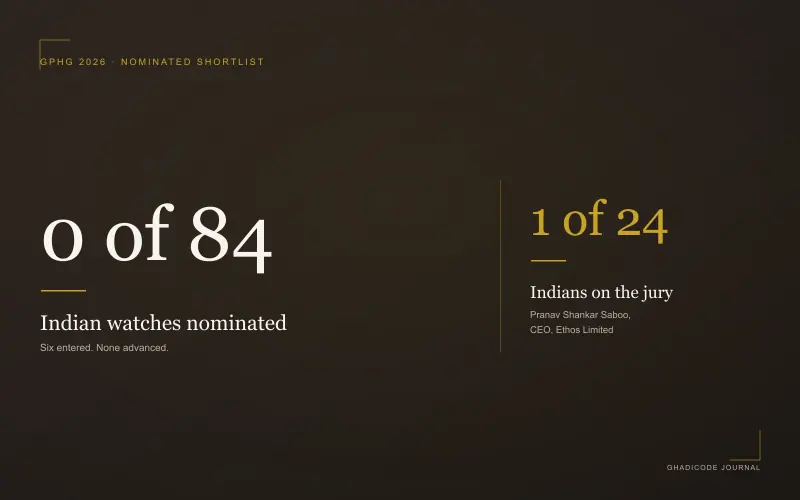
The GPHG overlap. Pranav Shankar Saboo, Ethos's MD and CEO — described as a second-generation entrepreneur in a group whose chairman, Yashovardhan Saboo, founded both KDDL and Ethos — sits on the GPHG 2026 jury while a group-controlled brand, Favre Leuba, is nominated in the Challenge category. Brand-affiliated jurors are standard at the GPHG, but the overlap is a fact readers should hold when the results are read out on 7 November.
Why this matters beyond one company
India's watch conversation usually splits into two stories: big domestic brands like Titan, and the micro-brand scene assembling watches with imported movements. The KDDL group belongs to neither, and is arguably more consequential than both.
It is the only Indian business that has climbed the value chain from the bottom rather than entering at the top. It started with components, earned Swiss customers on manufacturing quality, used retail profits to fund the climb, and bought a Swiss brand with real heritage when one came up cheap from a seller who had given up on it. That is the pattern by which watchmaking capability actually transfers between countries — Japan did a version of it, and so did the Swiss groups themselves.
For the broader Indian watch market, the significance is what it proves: an Indian company can own the parts of the industry that carry the margin and the credibility, not just the storefront. Whether it ends with an Indian-controlled brand winning in Geneva is an open question. The structure to try now exists.
Frequently asked questions
Who owns Ethos Watches? Ethos Limited is majority-owned by KDDL Limited, a Chandigarh-based watch components manufacturer founded in 1981. KDDL held roughly 75% before Ethos's 2022 IPO and retains a controlling stake, consolidating Ethos as a subsidiary.
What does KDDL actually make? Watch dials, hands and precision components, manufactured in India and exported largely to Swiss watch brands, plus Swiss-made dials and hands through its subsidiary Estima AG, precision engineering under Eigen, and luxury packaging under Ornapac.
Does KDDL own Favre Leuba? Yes, indirectly. Favre Leuba GmbH is wholly owned by Silvercity Brands AG, in which KDDL holds 93.07% directly and indirectly through Mahen Distribution and Ethos. Ethos separately holds 33.88% of Silvercity.
What was KDDL's revenue in FY25? Consolidated total income was ₹1,695 crore with PAT of ₹142.3 crore. KDDL standalone revenue was ₹384 crore with a 23.1% EBITDA margin.
Is KDDL an Indian company? Yes. KDDL Limited is Indian, headquartered in Chandigarh and listed on Indian stock exchanges, with manufacturing in India and subsidiaries in Switzerland.
The bottom line
Ethos is the part of this group everyone can see, and it is the least unusual part of it — a very good retailer in a growing market. The interesting company is the one behind it. KDDL spent four decades making dials and hands well enough that Swiss brands kept buying them, then used that position, and its retail cash flows, to buy a Swiss maison the Tatas had written off.
Whether the Richemont comparison ever holds is not the point yet. The point is that one Indian group now controls components, a Swiss brand and the country's largest luxury retail network at the same time, and has said out loud that cases are next. In an industry where India has spent a century as a customer, that is the most structurally ambitious thing anyone here is doing — and the reason to read the GPHG 2026 result as more than a list of Swiss winners.